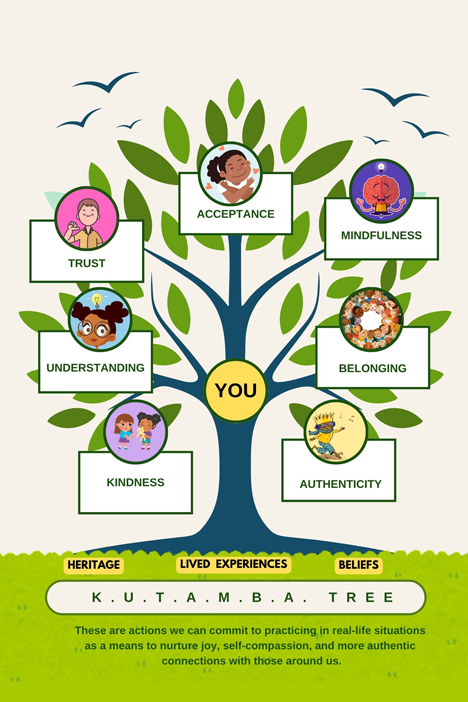
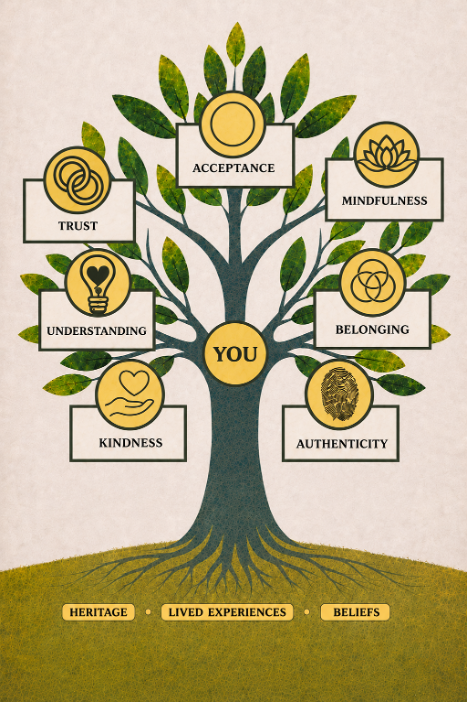
The Tree

The K.U.T.A.M.B.A. Tree offers a way of understanding how our lives are shaped by what grounds us, who we are, the values that guide us, and the impact we make. What we practice in our daily lives is connected to what has formed us, what we are learning about ourselves, and the values we choose to carry into the world.

Roots

The roots represent the parts of us that ground us. They include our heritage, lived experiences, beliefs, relationships, memories, and sense of purpose. They shape how we see ourselves, what we value, and how we move through the world.

Trunk

The trunk represents the self. It is the place where our roots are held and where growth begins. Before we can move outward into relationship and community, K.U.T.A.M.B.A. invites us to return to ourselves with honesty, gentleness, and attention. The trunk reminds us that knowing who we are matters. It helps us stand with greater steadiness in the world around us.

Branches

The branches represent the seven K.U.T.A.M.B.A. values that guide the way we relate to ourselves and one another. Kindness, Understanding, Trust, Acceptance, Mindfulness, Belonging, and Authenticity are practices we can return to again and again. They help us make choices, build relationships, and move through our communities with greater care and intention.

Leaves

The leaves represent the actions we take and the impact that grows as we practice the seven values. The leaves remind us that small, everyday choices matter. Together, those choices become part of the legacy we leave behind.

With gratitude to Jess Garcia and Liz Fortier, who beautifully reimagined the original K.U.T.A.M.B.A. Tree for use with children. Their creativity helped shape the K.U.T.A.M.B.A. Tree as it stands today.

Children’s Tree

The seven K.U.T.A.M.B.A. values are for every age. Young children can begin to learn and practice them through the intentional planning, modeling, and care of the adults who teach and nurture them.

One value can be introduced at a time and paired with a simple, developmentally appropriate question that children can hold and return to. Through stories, play, everyday routines, and conversation, children can reflect on how they have shown a value, how someone has shown it to them, and what it might look like to practice it with others.

The invitation remains the same. We begin within by noticing ourselves and our feelings. We then relate by considering how our actions affect the people around us. Finally, we rise by putting the value into practice in our classroom, family, or community.

Over time, the values become more than words. They become part of the way children learn to care for themselves, one another, and the spaces they share.